
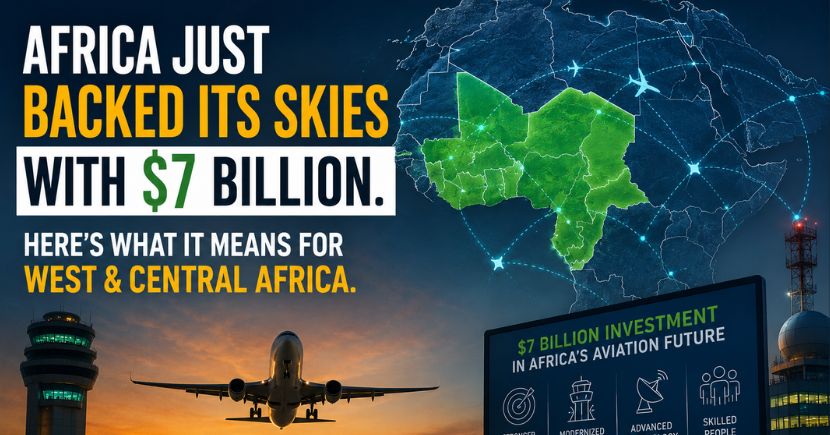
The African Development Bank's landmark Integrated Aviation Transformation Programme is the most significant continental aviation commitment in a generation. For West and Central Africa, long underserved and under-connected, this isn't just funding. It's a paradigm shift.
Africa Just Backed
Its Skies with $7 Billion.
Here's What It Means
for West & Central Africa.
The African Development Bank's landmark Integrated Aviation Transformation Programme is the most significant continental aviation commitment in a generation. For West and Central Africa, long underserved and under-connected, this isn't just funding. It's a paradigm shift.
A $7 Billion Programme That Changes the Continental Calculus
On June 2, 2026, in Brazzaville, Republic of Congo, the African Development Bank Group (AfDB) unveiled what is now the most consequential aviation commitment the continent has ever seen. The Integrated Aviation Transformation Programme (IATP), a $7 billion, five-year initiative, was presented at the AfDB's 2026 Annual Meetings as part of a sweeping strategy to mobilise capital, reduce financing risks, and accelerate infrastructure development across Africa.
The timing could not be more significant. Africa's aviation sector has already moved beyond post-pandemic recovery. Continent-wide passenger demand rose by 11.7 percent in early 2026, while air cargo expanded by more than 18 percent, both exceeding global averages. Yet despite this surging demand, the structural underpinning of African aviation has long lagged behind: ageing fleets, under-capitalised airlines, fragmented regulatory environments, and airports built for a different era of travel.
The IATP is designed precisely to address those gaps. Over the next five years, it will direct capital toward fleet modernisation, airport upgrades, logistics improvements, airport transport integration, aviation policy reform, workforce development, and, critically, making finance available for fleet acquisition at competitive rates.
This is not just another policy document. It is a $7 billion financing facility specifically designed to modernise African fleets over the next five years, finally decoupling fleet growth from sovereign debt.
…Aviation Metric, March 2026, on the IATP launch
Nigeria was among the first to formalise its commitment, with the Nigeria–AfDB framework partnership agreement signed on the sidelines of the Annual Meetings. Nigeria's Minister of Aviation and Aerospace Development, Festus Keyamo, serving as African Champion of the IATP, positioned Nigeria as both a key beneficiary and an implementation hub, highlighting the newly approved Nigeria Aircraft Leasing Company as a platform for fleet expansion.
West & Central Africa: The Region That Has the Most to Gain
Of all Africa's sub-regions, West and Central Africa stand at the most critical juncture. It is home to some of the continent's largest populations and fastest-growing economies , yet it has historically been among the most poorly served by intra-African air connectivity. Passengers travelling between Lagos and Douala, Abidjan and Libreville, or Accra and Kinshasa have for decades faced a cruel irony: it is often faster, cheaper, and easier to connect through Paris or Casablanca than to fly direct.
That reality is now being dismantled from multiple directions simultaneously.
- 110 million+ passengers projected for West & Central Africa by 2040 (AeroWest/ICAO projections)
- 24 WACAF states now operating under Free Route Airspace following the October 2025 AFRAA rollout
- 1,393 cumulative flight hours saved annually under FRA, with 5,000 metric tons of fuel burn reduced (AFRAA/Aviation Week)
- 16,000 metric tons of CO₂ avoided each year through Free Route Airspace operations (AFRAA)
- Nigeria is executing ₦712 billion (~$447M) rehabilitation of Murtala Muhammed International Airport Terminal 1, Lagos (FAAN)
- ASKY Airlines (Togo) is expanding its intra-West Africa network from Lomé, connecting to 23+ destinations
- Africa's blocked airline funds: $954 million (79% of the global total) trapped on the continent, a barrier IATP directly targets (IATA, October 2025)
On October 30, 2025, the African Airlines Association (AFRAA) achieved one of the region's most significant operational milestones in decades: the full deployment of Free Route Airspace (FRA) across the Western and Central African (WACAF) region. Transitioning from trials begun in November 2023, FRA now allows any airline to plan and fly User Preferred Routes (UPRs) across the entire WACAF region, flying the most fuel-efficient and timely paths based on real-time conditions, rather than fixed corridors.
AFRAA Secretary General Abdérahmane Berthé described the launch as a "game-changer," saying it will significantly enhance the competitiveness of African carriers by cutting flight times, fuel consumption, and emissions. The rollout, supported by Afreximbank and stemming from a joint resolution during a workshop in Dakar, Senegal, is also deeply strategic: it underpins both the Single African Air Transport Market (SAATM) and the African Continental Free Trade Area (AfCFTA), lowering barriers to air mobility and increasing route frequency and reliability across the region.
From mid-2026, the process is further streamlined: following the final administrative work by all 24 WACAF states, approvals will no longer be required for new UPR requests.
What the $7 Billion Means: Six Transformative Benefits
The IATP, combined with the broader $30+ billion continental infrastructure wave now underway, generates benefits that cascade across economics, connectivity, sustainability, and sovereign competitiveness. For West and Central Africa specifically, these translate into six interlocking advantages:
Fleet Modernisation at Scale
IATP's core mandate is to make finance available for fleet acquisition. The AfDB–AFRAA collaboration with Afreximbank creates a financing pool explicitly designed to break Africa's dependence on expensive sovereign-backed aircraft leasing. Modern, fuel-efficient fleets reduce operating costs by up to 20% and unlock access to high-demand thin routes previously uneconomical.
Airport Infrastructure Overhaul
Nigeria's $447M MMIA Lagos Terminal 1 rehabilitation, a full demolition and rebuild, is emblematic of the moment. From Abuja to Douala, IATP funding accelerates airport upgrades that expand capacity, improve safety compliance with ICAO standards, and transform airports from transit bottlenecks into integrated economic hubs.
Intra-Regional Connectivity
The $7B programme is explicitly linked to SAATM implementation. For West and Central Africa, where fewer than 20% of city pairs have direct air service, this means new routes, more frequencies, and genuine competition. ASKY Airlines, RwandAir, and Air Côte d'Ivoire are already operating UPRs, proving the commercial viability of direct regional routes when airspace and financing align.
Workforce & Capacity Development
One of IATP's five strategic pillars is to develop aviation workforce capacity. For a region that has long relied on expatriate pilots, engineers, and technicians at enormous cost, localising talent creates multiplier effects: lower salary repatriation, stronger technical ecosystems, and youth employment in one of the continent's fastest-growing sectors.
Sustainability & SAF Pathway
IATP includes explicit recognition that sustainable aviation fuel (SAF) must be made available in Africa at competitive rates. AFRAA's SAF working groups are targeting in-continent supply chains, removing the cost premium that has kept African carriers outside global decarbonisation commitments. Free Route Airspace alone already prevents 16,000 metric tons of CO₂ annually in WACAF.
Air Cargo & Trade Logistics
With African air cargo expanding by more than 18% in early 2026, outpacing passenger growth, IATP's logistics improvement mandate targets the cold-chain, freight handling, and intermodal infrastructure that converts airport investment into trade facilitation. For West Africa's agricultural exporters and manufacturers, this is the connective tissue of AfCFTA made real.
What the Agencies Are Saying: IATA, ICAO, AFRAA & FAAN
IATA's 2026 forecast for Africa is one of qualified optimism backed by structural urgency. Africa's aviation market is projected to grow at 4.1% annually over the next 20 years, reaching 411 million passengers, the world's third-fastest growth rate. The body also flags that Africa holds 79% of the world's blocked airline funds ($954 million of a global $1.2 billion), concentrated in markets including Algeria. IATA's prescription aligns precisely with the IATP: recognise aviation as a strategic economic enabler, not a revenue source, and avoid excessive taxes and charges that price out passengers and carriers alike.
ICAO's WACAF Office has been active in parallel regulatory work, from convening regional volcanic ash safety workshops in Yaoundé (June 2025) to supporting the Free Route Airspace implementation that now covers all 24 WACAF member states. ICAO's standards alignment remains a prerequisite for IATP disbursements, creating a virtuous circle: investment incentivises regulatory reform, which unlocks further investment.
AFRAA has been the central connective tissue. Its Airlines, Capital and Connectivity Forum, which brought the AfDB and Afreximbank into dialogue, produced the financing pool concept that now sits at the heart of IATP. AFRAA's confirmation that at least six African carriers (Ethiopian Airlines, Kenya Airways, EgyptAir, RwandAir, ASKY Airlines, and Royal Air Maroc) are already flying UPRs in WACAF validates the operational framework that IATP will now supercharge.
FAAN (Federal Airports Authority of Nigeria) is the regional anchor project. The ₦712 billion rehabilitation of Lagos Terminal 1, leaving only the structural pillars of the existing 50-year-old building, is not merely a renovation. It is a statement of intent: that West Africa's largest aviation market is rebuilding itself from the ground up to absorb the traffic IATP will generate.
The Next Five Years: From Capital Commitment to Operational Reality
The $7 billion IATP does not exist in isolation. It lands in a West and Central African aviation market that is already being reshaped by convergent forces: a continent-wide infrastructure investment wave exceeding $30 billion, Free Route Airspace now operational across WACAF, the AfCFTA framework creating demand for physical trade logistics, and a young, increasingly mobile population whose appetite for air travel is growing faster than almost anywhere else on earth.
Boeing's 2025 Commercial Market Outlook projects Africa's passenger air traffic growing at an average annual rate of approximately 6% through 2044, with a doubling of aircraft on the continent required to meet that demand. The IATP's fleet financing mandate is timed precisely to meet that inflection point before it becomes a crisis of unmet demand.
The near-term pipeline is already concrete. In the WACAF region alone, Nigeria's airport rehabilitation is progressing toward a 22-month completion; ASKY Airlines is expanding its network from Lomé across West and Central Africa and adding East African connections; and the 24 WACAF states are completing administrative procedures to make Free Route Airspace approvals fully automatic by mid-2026. By 2026's close, the airspace over West and Central Africa will be freer, more efficient, and better connected than at any point in the region's aviation history.
Aviation is no longer seen only as a means of moving passengers, but as an engine for moving economies. What makes 2026 especially significant is the nature of the capital now flowing in, more targeted, more strategic, and increasingly linked to trade, logistics, and industrial development.
…African Leadership Magazine, April 2026
The long-term outlook is equally compelling. ATTA's Africa in the Air White Paper projects West and Central Africa exceeding 110 million air passengers by 2040. In early 2026, 182.4 million departure seats were already scheduled across the entire continent, a 13.7% increase on 2025. The structural story is unambiguous: demand is real, growing, and increasingly backed by institutional capital willing to take a long-term position on Africa's skies.
The question is no longer whether West and Central African aviation will take off. The question is who will be positioned to benefit when it does.
Unlock the Potential at AeroWest 2026
The $7 billion IATP has set the runway. AeroWest 2026 is where the industry takes flight. As the premier aviation conference and exhibition dedicated exclusively to West & Central Africa, AeroWest is where airlines, OEMs, regulators, investors, and innovators converge to translate capital commitments into commercial partnerships.
From fleet financing and airport investment to regulatory reform and sustainability, AeroWest 2026 is where the aviation future of West & Central Africa is being decided. Explore $25B+ in infrastructure and fleet development projects. Engage with the airlines, OEMs, and regulators steering the IATP. Don't observe the transformation from the outside.
Comments (0)